How Strong Are Your Passwords?

By Dora, ForeverGeekApril 02, 2010 at 08:51AM

Do you pay as much attention to your passwords as you need to? I will have to be honest and say that I probably need to be more vigilant in this regard. For the time that I spend online and all the sites that I gain secure access to, I do not really put that high of a priority in strong passwords. What I read today has made me think really hard, though.

John Pozadzides, Internet standards expert, CEO of web company iFusion Labs, and blogger recently published an article titled “How I’d Hack Your Weak Passwords.” What he revealed is striking, to say the least.

We all know that the longer the password, the better. Combining letters and numbers is even better. Using a mixture of lowercase letters and capital letters is another way to strengthen your password. We KNOW all these things. But, did you know just how much of a difference using ONE capital letter in your password can make? Check out this table below. It shows the time an average computer will need to figure out the password for an account using certain programs (which, by the way, can be found FREE online!).

With this in mind, I wouldn’t be surprised if you start changing your passwords now. I suggest that you read the full article as it provides more specific information on how to make your passwords stronger. Passwords are your first (and oftentimes last) line of defense, and yet sometimes, they are taken for granted.

April Fools’ Day comes to… copyright law?

By nate@arstechnica.com (Nate Anderson), Ars TechnicaApril 01, 2010 at 04:24PM

So, have you heard about this crazy new bill in the Senate, S. 4110 (PDF)? Yeah, we hadn’t either, but apparently it will put an end to the entire Internet in the guise of protecting copyright holders.

Titled “Protecting America’s Greatest Treasure Act of 2010,” the new bill finds “that any uncompensated access to intellectual property undermines the fabric of society and will lead to untold Very Bad Things.” In addition, Congress believes that “we, as a country, have an obligation to Think of the Children.” That’s why all network engineers are classed as “enablers” of online copyright infringement and must monitor their networks and report violations immediately.

The bill also sets up a Cultural Protection Administration that “shall protect the interests of Members, as such Members are the true standard bearers of everything that is great and good about America.” One of its jobs shall be to screen films for Congressional staff, and the screenings “should take place, to the extent possible, in luxurious yet intimate theaters.”

Yes, it’s a joke. Copyright law might seem an unlikely subject for an April Fools’ Day joke, but Public Knowledge has found a way. The prank’s comedic value is limited—but you try writing a hilarious fake bill.

The Electronic Frontier Foundation also got into the fun today, taking aim at “three strikes” Internet disconnection laws. According to the EFF, “EU negotiators reportedly prefer a ‘carding’ system. ISPs that receive complaints would issue ‘yellow cards’ and ‘red cards,’ tracking the official penalty system of the Fédération Internationale de Football Association (FIFA).”

“These sports analogies are antithetical to the spirit of the open Internet,” said EFF International Director Gwen
Hinze. “The Internet is much more like the Force, which as Obi-Wan taught us all, ‘surrounds us and penetrates us. It binds the galaxy together.’ Evil Sith-Imperial complaints should not result in an individual being severed from the Force. That’s clearly preposterous.”

What’s your take? Funny—or should these groups stick to the lawyering and leave the comedy to others?

Read the comments on this post

Google Envelopes turns Gmail into snail mail, wraps it in precisely routed Maps printout

By Darren Murph, Engadget RSS FeedMarch 31, 2010 at 09:21PM


It’s a fantasy come true for the avid nerd / traveler, but unfortunately for us, it’s but a concept in its current form. Syracuse’s own Rahul Mahtani and Yofred Moik have dreamed up Google Envelopes, and if brought to production, this might just make the USPS as relevant as it was during the heyday known as 1985. Put simply, the solution would involve a new ‘Send Envelope’ method of passing along a note penned in Gmail; when pressed, you’d get a printout of the message along with a specially crafted envelope, the latter of which really makes this idea shine. The envelope itself would be a Google Maps representation of the quickest route to transfer said message from you to the recipient if roadways and kayaks were used in place of fiber and coax, giving the receiver a crucially awesome keepsake each time you dropped him or her a line. Oh, and having an ‘Avoid Tolls’ option would just totally put it over the top — even if were relegated to beta.

[Thanks, Yofred]

Google Envelopes turns Gmail into snail mail, wraps it in precisely routed Maps printout originally appeared on Engadget on Wed, 31 Mar 2010 20:21:00 EST. Please see our terms for use of feeds.

Permalink   |  sourceYanko Design  | Email this | Comments

DIY Pole-Mount for Your HDTV [DIY]

By Erica Ho, LifehackerMarch 31, 2010 at 06:00PM

DIY Pole-Mount for Your HDTVLooking for an interesting way to mount your sleek HDTV? Decorating blog IKEA hacker features an ingenious mounting guide involving a simple, inexpensive pole from IKEA.

Using the pole and other parts from IKEA, the post details how to fabricate the rails that attach to the TV, drill the necessary holes in each rail to match the mounting holes on the back of the television, and all the rest of the nitty gritty required to attach your HDTV to a pole. The author finishes up by using an angle bracket from a clothes rail installation kit. For easier assembly, it’s best to do it on the floor with the back side up. Then lift it into position and secure it.

DIY Pole-Mount for Your HDTVThe example above depicts a 32″ HDTV. If you’re concerned about stability, it may be wise to stick to a smaller TV upon attempting a project like this one—although the same IKEA pole works great as bike rack, so it seems like a relatively sturdy setup. (Just don’t blame us if anything goes awry!)

Do you have any interesting uses or places where you’ve mounted your TV? If so, sound off in the comments below.

Hang your TV on a pole [IKEA Hacker]

How Do You See Your Colleagues?

By Drea, Business PunditMarch 31, 2010 at 11:51AM

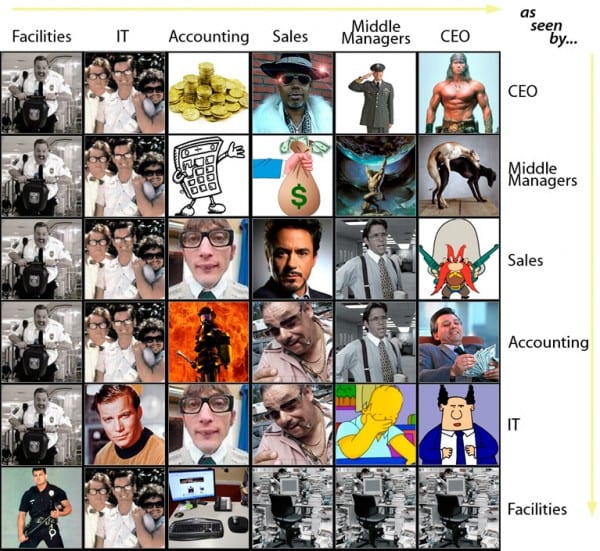
Who’s top dog in your office kingdom? If you’re convinced that the office would devolve into mayhem without your team’s contributions, you’re not alone–in thinking you’re the most important, that is. Most of us have the tendency to see our own contributions in a rosy light. Those colleagues on other teams tend to be, well, different. See where you figure into this grid. (If you’re on a team not mentioned here, comment on how you might see yourself and be seen by others!)

Click to Enlarge

PrimeSense fesses up: it’s the magic behind Microsoft’s Project Natal

By Darren Murph, Engadget RSS FeedMarch 31, 2010 at 10:00AM

Up until now, we haven’t actually been able to find out too much about the ins and outs of Project Natal. For all we knew, it’s a technology designed in the back stall of a unicorn barn, and the final name will somehow involve diphthongs from both “lasers” and “Robot Apocalypse.” All jesting aside, this really does mark the first bona fide announcement about the nuts and bolts behind Microsoft‘s forthcoming motion sensing add-on for its Xbox 360, and lo and behold, the revealing is being done by the same company we sat down with earlier this month at GDC. Quite a few of you assumed that PrimeSense’s webcam was indeed Project Natal in camouflage when we posted up our original hands-on, and while we couldn’t confirm or deny those suspicions at the time, we can today. So, what’s this mean for you? It probably means that PrimeSense is actively looking to get its 3D-sensing technology (which has obviously been tweaked quite a bit by Microsoft, to its credit) into as many living room scenarios as possible, so what you’re seeing in Natal might just appear elsewhere in the very near future. Did your imagination just run wild? No? Have a look back at our GDC experience and try again.

Continue reading PrimeSense fesses up: it’s the magic behind Microsoft’s Project Natal

PrimeSense fesses up: it’s the magic behind Microsoft’s Project Natal originally appeared on Engadget on Wed, 31 Mar 2010 09:00:00 EST. Please see our terms for use of feeds.

Permalink   |   | Email this | Comments

Tactile gaming vest lets you feel the pew pew pew

By Sean Michael Ragan, MAKEMarch 31, 2010 at 10:00AM

tgv3.jpg

tgv2-hs.jpg

Roboticist Saurabh Palan, a graduate student at the University of Pennsylvania, just hipped us to his “Tactile Gaming Vest” project. The vest contains solenoids, rumble-packs, and Peltier heating elements, and is designed to provide haptic feedback in first-person shooters. Get shot with a pistol, get a kick in the chest from a solenoid. Was it a laser? Add some local heat from the Peltiers. Vibration from the rumble-packs can be used to simulate explosions or slashing attacks. There’s more info at Palan’s personal site, iRoboticist.com. Double win for scoring that URL.

More:

Read more | Permalink | Comments |

Read more articles in Computers |

Digg this!

Glove Mouse project gives ‘pinch to zoom’ a new meaning (video)

By Tim Stevens, Engadget RSS FeedMarch 31, 2010 at 09:44AM

MIT's Glove Mouse brings new meaning to 'pinch to zoom' (video)

We never cease to be amazed by the number of projects spawned from that one scene in Minority Report where Tom Cruise goes massively multitouch, but we’ll also never tire of seeing those projects in action. The latest is the Glove Mouse from Tony Hyun Kim and Nevada Sanchez at MIT and, while they’ve been on the project for some time (winning the school’s George C. Newton Project Prize in 2009 for their work), they’ve recently made the gloves wireless and posted some photos and videos. Each glove sports an LED on the back of the index finger, picked up by a low-res webcam to act like a cursor, along with buttons under the index and middle fingers activated by the thumb. It’s a little like Wiimote meets Peregrine and the result has a lot of potential to say the least. Click on through for a rocking video demonstration, but be sure to dust off those Guitar Hero controllers before you do.

[Thanks, Nebada]

Continue reading Glove Mouse project gives ‘pinch to zoom’ a new meaning (video)

Glove Mouse project gives ‘pinch to zoom’ a new meaning (video) originally appeared on Engadget on Wed, 31 Mar 2010 08:44:00 EST. Please see our terms for use of feeds.

Permalink   |  sourceMIT  | Email this | Comments